History and meaning of the flag of the Dominican Republic
The flag of the Dominican Republic is one of the most recognizable national symbols in the Caribbean. Its design combines ultramarine blue, vermilion red and white in a very particular composition: a central white cross divides the field into four alternating quarters and, in the center, the national coat of arms appears. The Dominican Constitution recognizes the National Flag, the National Coat of Arms and the National Anthem as national symbols.
Beyond its official function, the Dominican flag sums up part of the country's historical identity: independence, faith, sovereignty, national unity and the memory of the patriots who took part in building the Republic. For those visiting the country, getting to know its symbols helps to better understand its culture, its national holidays and the pride with which Dominicans show their identity.
If you're planning a trip through the country and want to locate its main tourist areas, you can find more information in this guide on where Punta Cana is, one of the most international destinations in the Dominican Republic.
Design and colors of the Dominican flag
The flag of the Dominican Republic has a rectangular format and an official 2:3 ratio. According to the Ministry of Foreign Affairs, it is characterized by a white cross whose arms reach the edges and divide the flag into four quarters: two blue and two red, placed alternately. The first quarter, located next to the staff and at the top, must be blue.
This design is no accident. The distribution of colors and the presence of the white cross reflect a historical, patriotic and spiritual reading. The flag was conceived by Juan Pablo Duarte, and the first one was made by several patriot women, among them María Trinidad Sánchez, María de Jesús Pina, Isabel Sosa and Concepción Bona. It flew for the first time on February 27, 1844, the day of National Independence.
What blue, red and white represent on the flag
The colors of the Dominican flag have a very strong symbolic meaning. The Presidency of the Dominican Republic attributes to vermilion red the blood shed by patriots in the battles for independence; to ultramarine blue, the sky covering the homeland, divine protection and the ideals of progress; and to white, peace and unity among all Dominicans.
That's why the flag should not be interpreted merely as an aesthetic combination. Red connects with historical sacrifice; blue, with the idea of protection, faith and the future; and white, with the aspiration for national coexistence. This reading explains why the symbol has such a presence in official events, schools, public institutions and patriotic celebrations.
How the colors and the white cross are arranged
The Constitution establishes that the National Flag is composed of ultramarine blue and vermilion red in alternating quarters, separated by a white cross. It also indicates that the blue must be toward the upper part of the staff and that the national coat of arms is placed in the center of the cross.
The white cross is one of the most distinctive elements of the flag of the Dominican Republic. Visually, it organizes the design and separates the four blocks of color. Symbolically, it reinforces the idea of unity, peace and spirituality. It also helps to distinguish the Dominican flag from other tricolor flags in the region.
The national coat of arms on the flag of the Dominican Republic
One of the most singular features of the flag of the Dominican Republic is the presence of the national coat of arms at its center. Not all national flags incorporate a coat of arms, and in the Dominican case this element adds a very important symbolic layer.
The coat of arms shares the colors of the flag and is made up of several elements: an open Bible, a cross, spears, national flags without a coat of arms, laurel and palm branches, and two ribbons with inscriptions. According to the Constitution, the coat of arms bears at its center the Bible open to the Gospel of Saint John, chapter 8, verse 32, with a cross above it; it also includes a laurel branch on the left and a palm branch on the right.
The Bible and the cross: central symbols of the coat of arms
The open Bible and the cross are the most recognizable elements of the Dominican coat of arms. Their presence expresses the influence of the Christian tradition in the country's symbolic formation. The Constitution specifies that the Bible appears open to Saint John 8:32 and that a cross is placed above it.
This detail makes the flag an especially particular symbol within the international context. The religious dimension does not appear in a secondary way, but at the very center of the coat of arms, right where the arms of the flag's white cross meet.
Laurel and palm branches and the motto "Dios, Patria y Libertad"
The national coat of arms also includes a laurel branch and a palm branch. The Dominican Presidency explains that the laurel represents immortality and the palm freedom. At the top of the coat of arms there is an ultramarine blue ribbon with the motto "Dios, Patria y Libertad" (God, Homeland and Freedom), while at the base there is a red ribbon with the words "República Dominicana".
The national motto sums up three central ideas: the spiritual dimension, love for the homeland and the defense of freedom. That's why the Dominican flag works as a visual synthesis of the country's political, religious and cultural history.
Historical and cultural importance of the Dominican flag
The flag of the Dominican Republic has an importance that goes far beyond official protocol. It is a symbol of sovereignty, independence and collective identity. In the country it is displayed in public buildings, educational centers, institutional events and patriotic dates, especially on February 27, National Independence Day, and August 16, Restoration Day, both recognized as national holidays by the Constitution.
For the foreign visitor, observing the presence of the flag in streets, squares, schools and official buildings helps to grasp the weight of national memory. The Dominican Republic is a country of beaches, islands and Caribbean landscapes, but also of history, symbols and living culture. To explore that natural and tourist dimension, you can also read this guide on the best islands in the Dominican Republic.
The flag in independence and national identity
The first flag flew on February 27, 1844, the date of the proclamation of Dominican independence. Later, on November 6, 1844, the Constituent Congress adopted the National Flag as a symbol of the Homeland in the first Constitution.
Since then, the flag has consolidated itself as an emblem of unity. Its value lies not only in representing the State, but in connecting Dominicans with a shared history. For the Dominican diaspora, the flag is also an emotional link with their country of origin and a way of expressing belonging from abroad.
Curiosities and interesting facts about the flag
One of the most notable curiosities of the flag of the Dominican Republic is that its coat of arms includes an open Bible, an uncommon feature on national flags. It's also relevant that the merchant flag is identical to the national one but without the coat of arms, as stated in the Constitution.
Another curiosity is its protocol of use. The flag must not touch the ground, must not be displayed in poor condition, and must be placed correctly depending on whether it is in a vertical or horizontal position. The Ministry of Foreign Affairs indicates that the upper blue quarter must be in a specific position according to the form of display, which shows the level of detail with which this national symbol is protected.
Getting to know the Dominican flag is a simple way to get closer to the soul of the country. And for those who, beyond traveling, are considering living or investing in the Dominican Republic, projects like Horizon View make it possible to connect that cultural and tourist interest with a residential vision in Punta Cana.
Written by
Larimar City & Resort
Featured projects
Explore the residential projects of Larimar City mentioned in this article.


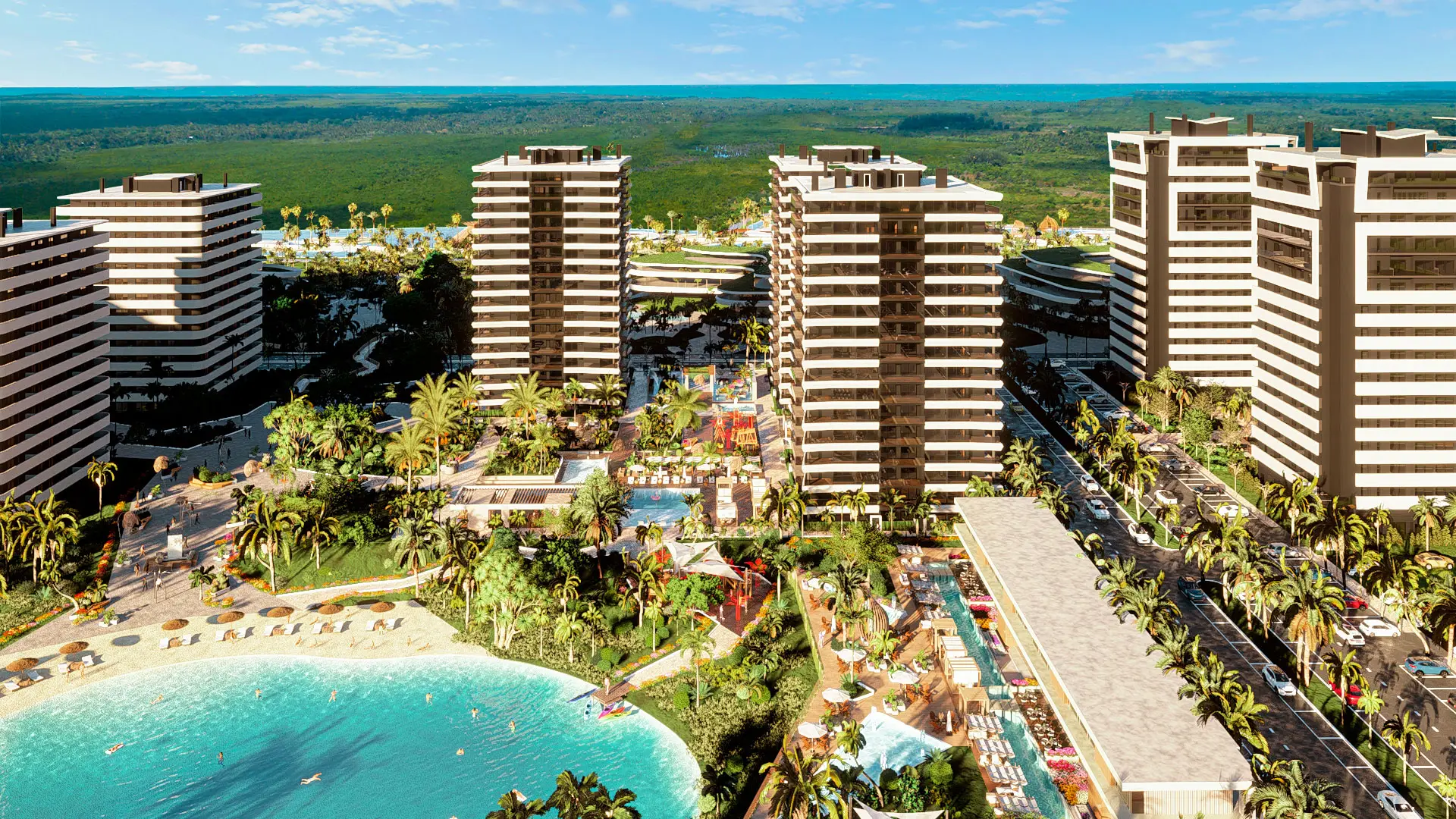
Smart Investment
Join the first Smart City in the Caribbean. Discover how Larimar City redefines safety and property value in Punta Cana.
Request information